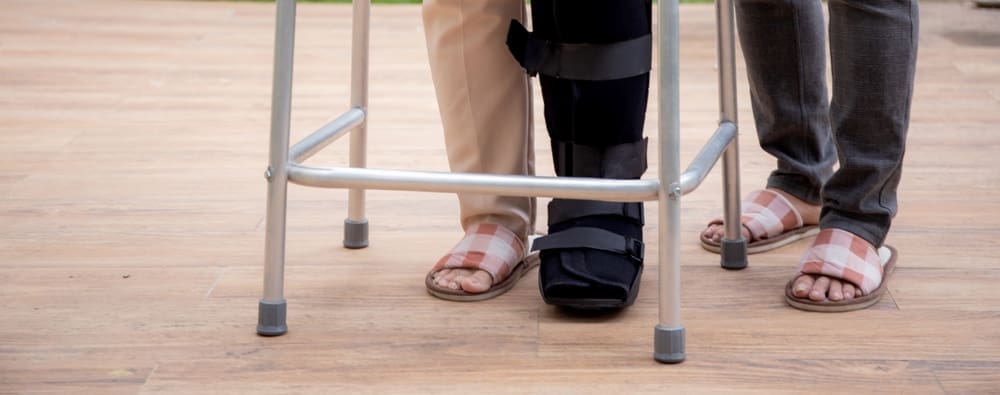
After foot or ankle surgery, one of the first challenges usually isn’t the pain. It’s figuring out how you’re going to get around while your foot heals.
Making breakfast, getting to the bathroom, answering the door, or moving from one end of the house to the other can suddenly require some planning.
If your surgeon has told you to limit or avoid putting weight on your foot, you may be considering a knee scooter or walker. Both can make recovery easier, but they solve the problem in very different ways.
The better choice depends on your weight-bearing restrictions, balance, strength, home layout, and what everyday life will look like while you recover.
Start With Your Weight-Bearing Instructions
Before deciding between a knee scooter and a walker, make sure you understand exactly what your surgeon means when discussing weight-bearing.
You may be told that you’re non-weight-bearing, meaning you shouldn’t place weight on the recovering foot at all. Other patients may be allowed partial or progressive weight-bearing as healing advances.
Those instructions can change throughout recovery, so the mobility aid that works best during the first few weeks may not be what you need later.
Your surgeon or physical therapist should ultimately determine what’s appropriate for your specific recovery. The American Academy of Orthopaedic Surgeons also provides patient education about foot and ankle conditions and rehabilitation, but your own care team’s instructions should always come first.
Knee Scooter vs. Walker: Quick Comparison
|
Consideration
|
Knee Scooter
|
Walker
|
|
Best suited for
|
Longer periods of non-weight-bearing recovery
|
Stability and supported walking
|
|
Getting around longer distances
|
Generally easier and faster
|
Requires more effort
|
|
Tight spaces
|
Can be harder to turn and maneuver
|
Often easier to position
|
|
Upper-body effort
|
Generally less
|
Can require more arm and shoulder strength
|
|
Stairs
|
Cannot be used on stairs
|
Requires careful planning and guidance but not recommended
|
|
Uneven outdoor surfaces
|
Can be challenging
|
May provide better stability depending on the surface
|
|
Balance required
|
Requires balance and coordination to steer and stop
|
Provides a wider, stable base
|
|
Later stages of recovery
|
May become less necessary as weight-bearing increases
|
Can help during the transition back to walking
|
|
Easy to transport
|
Depends on scooter size and vehicle
|
Many walkers fold for transportation
|
|
Rental option
|
Knee scooter rentals
|
Walker and rollator rentals
|
Neither option is automatically better. Your surgeon’s weight-bearing instructions come first, followed by practical considerations like balance, upper-body strength, the layout of your home, and how you’ll spend your time during recovery.
When a Knee Scooter Makes Everyday Life Easier
A knee scooter lets you rest the knee of your recovering leg on a padded platform while propelling yourself with your other foot.
For someone who needs to remain completely off one foot, this can feel much more natural than hopping behind a walker or managing crutches.
It can be particularly useful when you’re moving longer distances on a relatively level surface.
Think about a typical trip through the house.
With a knee scooter, you may be able to move from the bedroom to the kitchen, roll down a hallway, or get around an open living area without putting weight on the recovering foot.
Many people also appreciate being able to remain upright without placing as much demand on their arms as some other mobility aids require.
If you expect to be non-weight-bearing for several weeks, a knee scooter rental can be a practical way to get through the temporary recovery period without purchasing equipment you may not need afterward.
Where a Knee Scooter Can Become Awkward
A knee scooter works best when it has room to move.
That matters because homes aren’t always designed that way.
Tight bathrooms, narrow hallways, thick rugs, small kitchens, sharp turns, and cluttered rooms can make maneuvering a scooter more difficult.
Stairs are another obvious limitation. You can’t simply ride a knee scooter up or down a staircase.
Outdoor surfaces deserve consideration too. Uneven pavement, gravel, grass, curbs, and steep slopes can be much more challenging than a smooth floor.
Before choosing a scooter, picture the routes you’ll actually take during recovery rather than just thinking about whether the scooter itself seems comfortable.
When a Walker May Be the Better Choice
A walker provides something different: stability.
Instead of supporting your recovering leg on a platform, you use the walker to create a stable base as you move.
That can be useful when balance is the bigger concern or when your healthcare provider wants you gradually placing some weight on the recovering foot.
A walker may also be easier to position in certain tight spaces where turning a knee scooter would be difficult.
Later in recovery, your needs may change again. As your surgeon allows you to put more weight on your foot or ankle, a walker can provide support during that transition.
That’s one reason this doesn’t always have to be a knee scooter or a walker decision.
You might use both at different stages.
Your House May Decide for You
One of the best ways to make this decision is to walk through your home before surgery.
Not literally with the equipment—just imagine the route.
Start where you’ll spend most of your time.
How will you get from your chair or bed to the bathroom?
Can you turn around in the bathroom?
Is there enough room beside the toilet?
What about the kitchen?
Are there steps between different areas of the house?
Do you have thick rugs or transitions between flooring surfaces?
A knee scooter may be fantastic in an open single-level home but frustrating in a small house with tight corners and several sets of stairs.
A walker might be slower for moving longer distances but easier to position where space is limited.
Your home is part of the decision.
Think About Your Hands and Upper Body Too
Your foot isn’t the only part of your body involved in getting around.
Using a walker can place significant demands on your arms, shoulders, and hands, particularly when you’re trying to keep weight completely off one leg.
That may be difficult for someone who already has arthritis, shoulder problems, limited grip strength, or upper-body weakness.
A knee scooter changes that dynamic because your recovering leg is supported on the knee platform.
However, you still need enough balance, coordination, and control to steer and safely operate the scooter.
Neither option is automatically easier for everyone.
What About Leaving the House?
Your needs outside the home may be completely different.
A knee scooter can be convenient for appointments, shopping, or other outings where there’s a lot of smooth, level ground to cover.
But consider how you’ll transport it.
Can you get it into your vehicle? Will someone be available to help if needed? What kind of surfaces will you encounter once you arrive?
There may also be times during recovery when neither a knee scooter nor walker is ideal. If you’re facing a long outing shortly after surgery, conserving energy with a temporary wheelchair rental may make more sense than trying to navigate a large facility while non-weight-bearing.
The goal isn’t to use one piece of equipment for absolutely everything.
It’s to make recovery manageable.
You May Need Different Equipment at Different Stages
Recovery changes.
During the first couple of weeks, keeping all weight off your foot may be the priority. A knee scooter might be what gives you the most independence.
Later, your surgeon may allow you to begin gradually putting weight on the foot. At that point, a walker or rollator may become more useful as you transition toward walking normally again.
That’s also why renting can make sense after foot or ankle surgery.
You aren’t necessarily choosing mobility equipment for the next several years. You’re choosing what helps you safely get through a specific stage of recovery.
So, Which One Is Better?
There isn’t one answer that applies to everyone.
A knee scooter may be a good fit when you need to remain non-weight-bearing, have adequate balance and coordination, and will primarily travel across smooth, relatively open surfaces.
A walker may make more sense when stability is the priority, space is limited, or you’re transitioning into partial weight-bearing under the direction of your care team.
And sometimes the most practical answer is using different equipment for different situations.
The important part is not trying to force your recovery around the equipment you happen to have. Your mobility equipment should make everyday life easier while still following the restrictions your surgeon has given you.
At Access Medical Equipment, we can help you look at the practical side of that decision: your home, how long you’ll need assistance, where you’ll be going, and what equipment may make those weeks of recovery easier.
You can visit our Seattle showroom or Renton showroom to see mobility equipment in person and get a better sense of what will work for you.
If your surgery is coming up, you can also reserve medical equipment online ahead of time. Getting the mobility question settled before surgery means you can come home focused on recovery instead of figuring out how you’re going to get from one room to another.